
How does wine consumption in Poland compare to other types of alcohol? Has the growing number of vineyards encouraged greater interest in wine? Let’s take a look at what the official data says.
Official sources and the latest figures
In Poland, data on alcohol consumption is published by the National Centre for Addiction Prevention. This institution’s website provides detailed reports (only in Polish) that allow us to track changes in the consumption of various types of alcohol — including wine and mead — over time.
According to the most recent data from 2023, the average Polish consumer drank 6.8 liters of wine and mead combined. In terms of pure alcohol, this corresponds to about 0.7 liters. Unfortunately, these statistics do not differentiate between wine and mead — they are treated as a single category.
Long-term stability
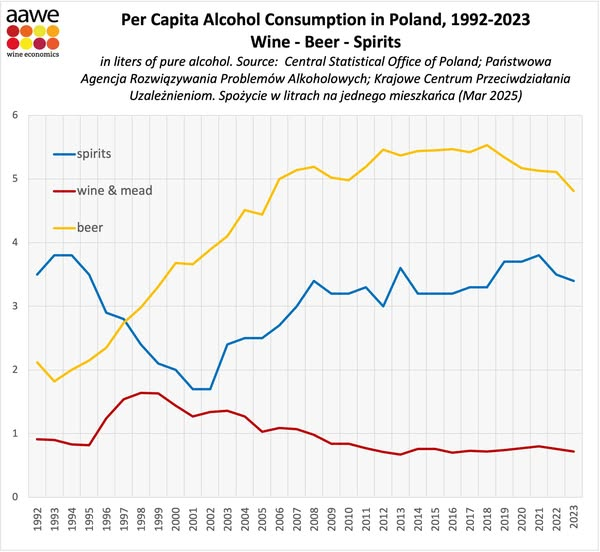
An analysis of the years 2008–2023 shows that the consumption of wine and mead has fluctuated between 5.8 and 8.2 liters annually. However, if we look further back, there is a clear downward trend. This is illustrated, for example, in a chart shared by the American Association of Wine Economists (AAWE) on their Facebook profile:
Wine remains a niche
Currently, only about 8% of total alcohol consumption in Poland comes from wine and mead. This is a significant drop from the early 2000s, when the share was around 20%. Interestingly, the liberalization of winemaking regulations in 2008, which made it easier to produce wine locally, did not result in a noticeable shift in consumption trends.
One of the reasons is the higher price of Polish wine compared to the average price Polish consumers are willing to pay. Polish society remains very price-sensitive, which does not encourage widespread adoption of locally made wines.
Another factor is the small number of vineyards and limited cultivation area, meaning that Polish wine production remains very low compared to the potential demand of a country with over 34 million inhabitants.
What does the future hold?
On one hand, it seems likely that economic growth and aspirations to follow more developed countries may lead to increased wine consumption. On the other hand, growing trends toward healthy lifestyles and efforts by younger generations to reduce alcohol intake, including wine, may effectively halt any potential rise.
For now, one thing is certain: wine and mead remain the third most popular category of alcohol in Poland, behind beer and vodka — and this is unlikely to change in the coming years due to the large consumption gap.

One thought on “Wine Consumption in Poland – Statistics”