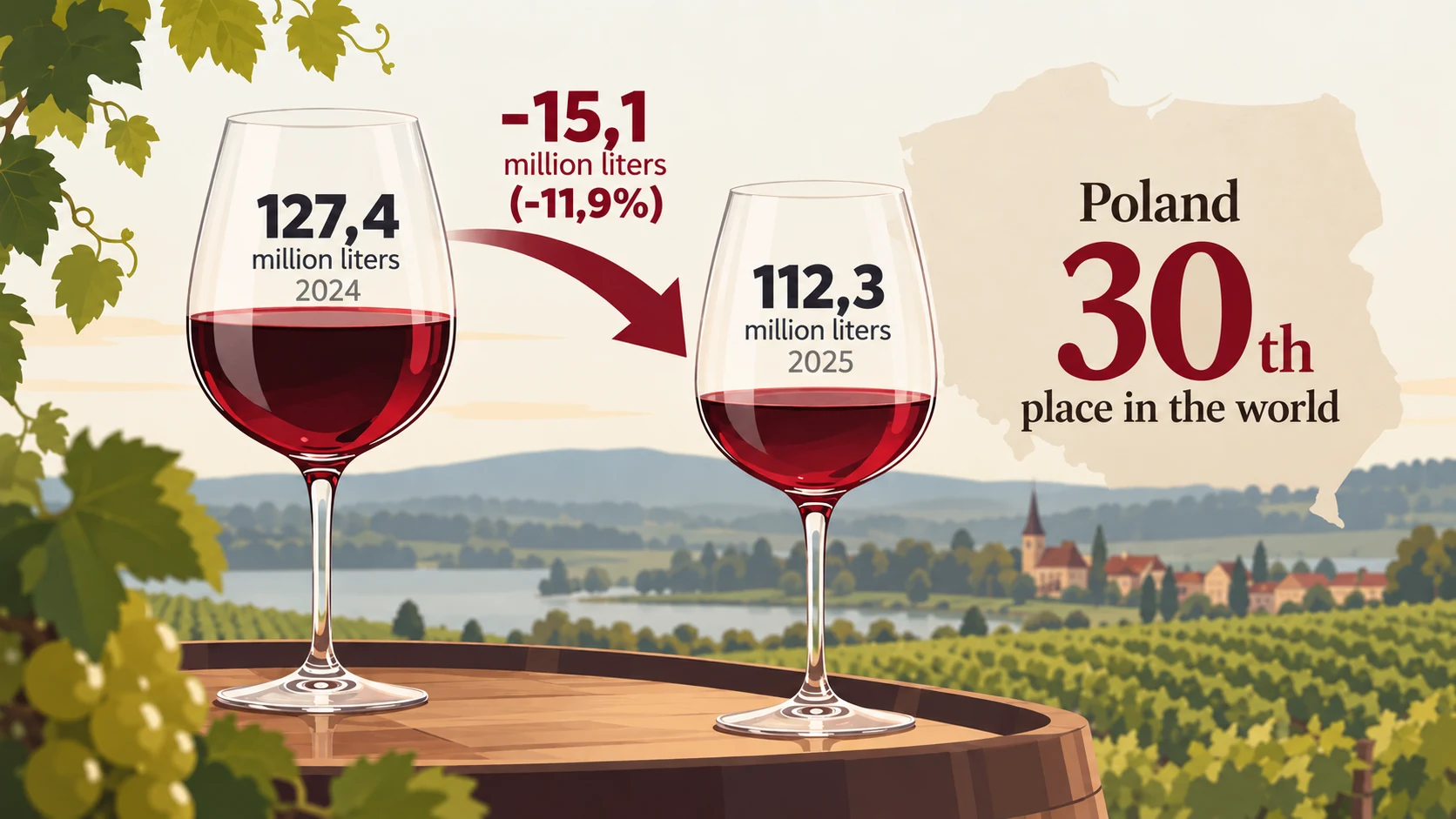
According to OIV data cited by the American Association of Wine Economists profile, Poland ranked 30th in the world by volume of wine consumed in 2025. Consumption amounted to 112.3 million litres, compared with 127.4 million litres a year earlier – a decrease of 15.1 million litres, or 11.9%.
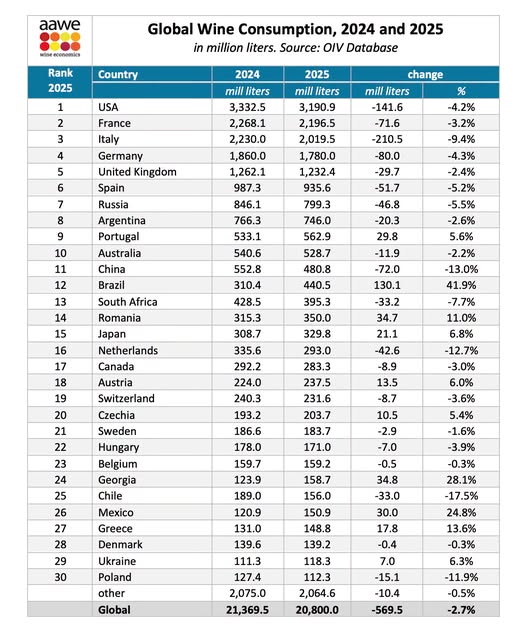
Poland in the OIV ranking
In the graphic published by AAWE, based on the OIV database, Poland ranked third among the largest percentage declines in consumption. Lower figures were recorded only in China (−13.0%) and the Netherlands (−12.7%).
The scale of the decline reflects a global trend. Global wine consumption fell from 21,369.5 million litres in 2024 to 20,800.0 million litres in 2025, a decrease of 569.5 million litres (−2.7%). The largest markets in 2025 included the United States, France, Italy, Germany and the United Kingdom.
Different source, different methodology
It is worth comparing these figures with our article about the wine consumption in Poland, based on KOWR data. However, these are different sources, and their values should not be treated as directly comparable. KOWR statistics report combined consumption of wine and mead, whereas the OIV data discussed here concern wine. According to KOWR data, combined consumption of wine and mead amounted to approximately 6.8 litres per person. It is almost twice as much as OIV reports (approximately 3.7 litres per person).
Domestic production is a small part of consumption
In the article about the production of Polish wine in years 2010-2025, we estimated that domestic production corresponds to around 70 ml per adult resident, assuming 30.7 million adult Poles. In relation to the 112.3 million litres of wine consumed in 2025, this represents around 1.9% of consumption. This is an indicative figure: Polish wine is also exported, so the actual amount of Polish wine consumed domestically per resident is lower than 70 ml.
Why is it worth following OIV data?
The International Organisation of Vine and Wine (OIV) is an intergovernmental organisation focused on the vine, wine and wine products sector. Its activities include collecting data, preparing analyses and supporting the harmonisation of industry standards. The figures used in the AAWE post come from the OIV database.
The full post, including the ranking, was published on the AAWE Facebook profile.


