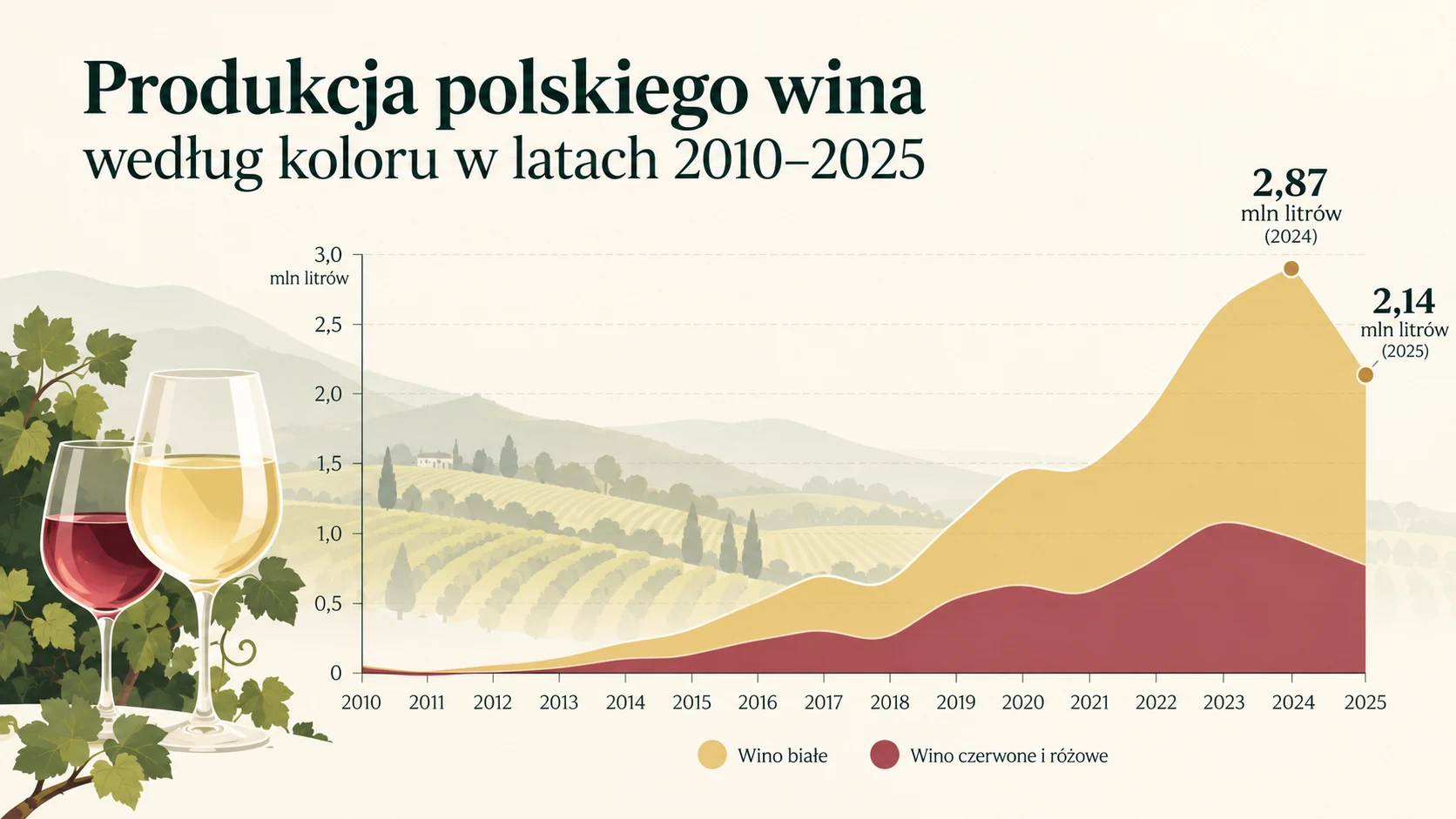
Polish wine production intended for commercial sale has increased significantly over the past 15 years. According to data from the National Support Centre for Agriculture (KOWR), it stood at 0.04 million litres in 2010 and reached 2.14 million litres in 2025. This represents an increase of more than 53 times.
These are the most precise available data on domestic wine production for commercial purposes. The compilation, also shared by the American Association of Wine Economists (AAWE), shows both the scale of development in Polish winemaking and the changing structure of production.
From 40 thousand litres to more than 2 million litres
In the first years covered by the data, production was still small: it amounted to 0.04 million litres in both 2010 and 2011. From 2013, it began to grow steadily, exceeding 1 million litres in 2019. Growth was particularly evident in 2022–2024, when production rose from 1.84 million litres to a record 2.87 million litres.
The highest result in the entire table was recorded in 2024. A year later, production declined to 2.14 million litres, but it was still clearly higher than in every year before 2023.
White wine drives growth
The most important change is the growing share of white wines. In 2025, 1.44 million litres were produced, compared with 0.71 million litres of red and rosé wines. White wines therefore accounted for around two-thirds of total production.
In every year from 2019 to 2025, white wine production exceeded that of red and rosé wines. In the record year of 2024, the difference was even greater: white wines reached 1.99 million litres, while red and rosé wines totalled 0.88 million litres.
How much Polish wine is produced per adult resident?
For comparison, assuming approximately 30.7 million adult Poles in 2025, domestic production corresponded to around 70 ml of wine per adult. This is an interesting reference point: despite strong growth, Polish winemaking still has considerable potential for further development.
KOWR data show that Polish wine has grown from a niche product into an increasingly visible part of the domestic market. White wines play a particularly important role in this process, with their production growing faster in recent years than the red and rosé wine segment.


